Stay Ahead with Expert-Led Insights

Navigating Complexity. Driving Progress. Creating Lasting Impact.

Welcome to the TeKnowledge Insights hub! Here, you’ll find a blend of strategic perspectives, real-world case studies, and expert analysis designed to empower organizationsto navigate challenges and seize new opportunities.

Explore the insights that matter most. Stay informed, gain new perspectives, and discover how businesses worldwide are unlocking new opportunities with TeKnowledge.

All Categories

The latest developments, strategic partnerships and milestones.

Global Connections, Local Impact: TeKnowledge in November 2025

What happens when strategy meets scale, and vision meets velocity? For us at TeKnowledge, November 2025 offered a powerful answer shaped by decision-makers like you. Across continents, we launched a new trajectory of impact: from learning to cybersecurity, and from AI-first policy to platform-scale implementation. It was a month defined not just by presence as well as purpose.

Our teams have connected with the leaders shaping tomorrow – decision-makers, regulators, innovators—and driving toward AI-First transformation. These conversations and collaborations reflect what’s possible when bold ambition meets expert execution, turning pilots into platforms and digital vision into enterprise-wide momentum. We guide leaders from reactive to predictive, siloed innovation to systemic change, making AI real, scalable, and ready for what’s next.


Middle East: Partnering with Microsoft to Shape AI-First Futures

Showing up with Microsoft in the United Arab Emirates and Kuwait

TeKnowledge demonstrated how AI is transforming industries and elevating customer experience across the Middle East. At both the Microsoft AI Tour in Dubai and the Microsoft AI Summit in Kuwait, our teams reinforced our strategic partnership with Microsoft and showcased the role of AI in enabling national transformation.

In Kuwait, we saw firsthand how the country is moving from AI ambition to execution—guided by Vision 2035. From Copilot and Azure to skilling programs and regulatory clarity, our engagements emphasized the power of pairing Microsoft solutions with human capability and institutional readiness. We shared real examples of transformation: frontline workers using Copilot to free up time for higher-impact work, and governments enhancing service capacity through automation.

These events underscored a shared mission: readiness to move from pilots to platforms and activating systemic change across government and private sectors. TeKnowledge is proud to be a trusted partner to Microsoft and its customers on that journey.


Mobile World Congress – Qatar

At MWC25 Doha, TeKnowledge joined forces with Microsoft to address one of the region’s most urgent imperatives: scaling AI from experimentation to enterprise-wide execution. At the heart of this year’s “AI Nexus” theme, we showcased how our five-pillar approach helps service providers unlock performance across every layer of the business, from secure data infrastructure and Copilot integrations to outcome-based skilling and governance.

Through real-world examples like Omantel, we demonstrated how collaborative use-case mapping, functional integration of Copilot, and hands-on skilling translate AI from promise to performance. MWC25 reinforced that AI is everyone’s business; and when powered by the right partnerships, the leap from pilot to platform becomes real.

Africa: November as the Month of Cybersecurity & Inclusion

Across Africa, November marked a defining moment in our commitment to cyber resilience and inclusive innovation. It was also the month we launched the AI-Ready Security Suite, a framework designed to help organizations embed proactive, AI-first cybersecurity at scale.

Rwanda Global Business Services Awards

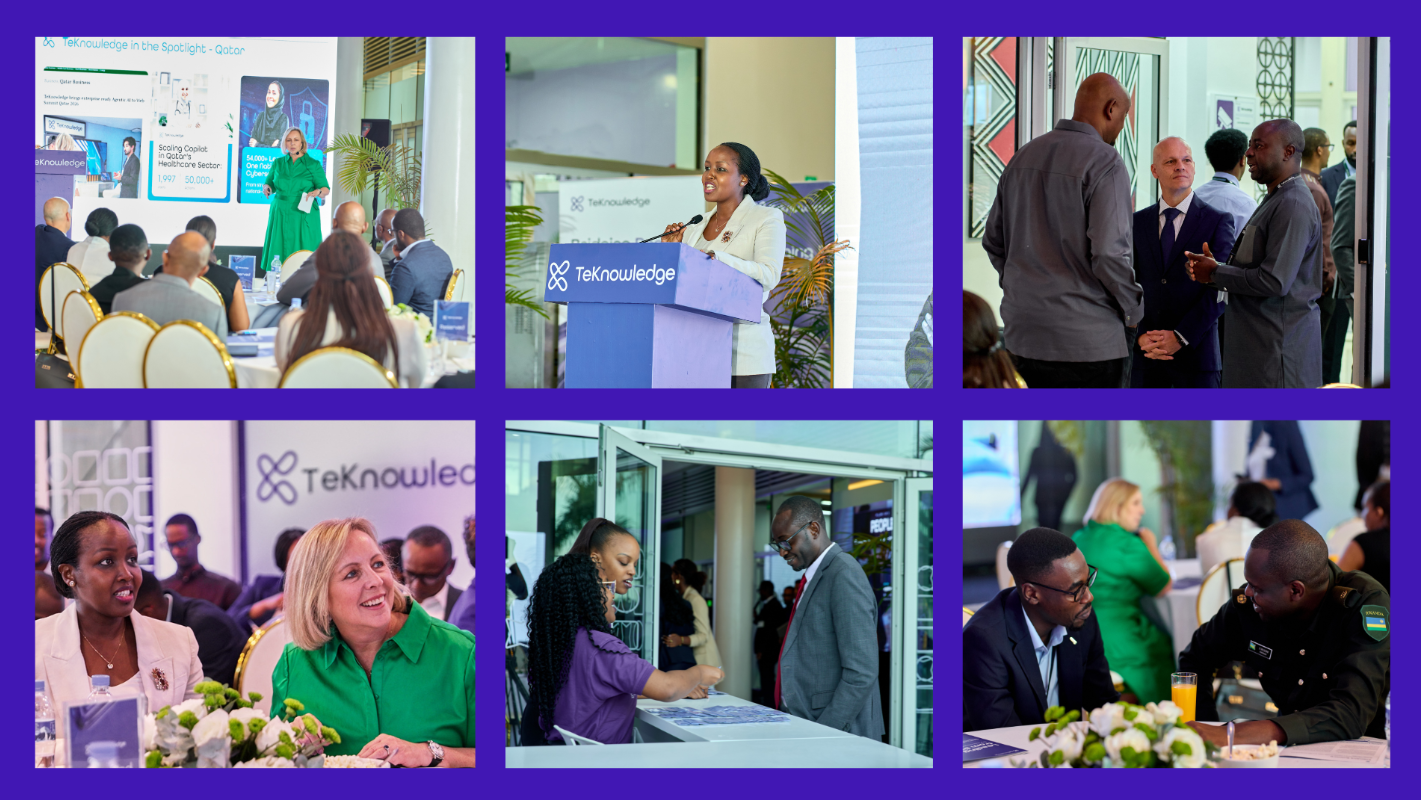
TeKnowledge Rwanda earned two major recognitions at the inaugural Rwanda Global Business Services Awards: ITO Company of the Year and the Inclusivity Award. These honours celebrate our delivery excellence, operational strength, and unwavering commitment to fostering an equitable, people-first workplace where talent can thrive.

ISC2 Cybersecurity Conference – Nigeria

TeKnowledge participated in the ISC2 Cybersecurity Conference, sharing insights on the evolving threat landscape and the growing importance of cybersecurity readiness. Territory Director for Africa, Olugbolahan Olusanya, delivered a keynote on AI-ready security frameworks, guiding organizations through the three essential pillars—Assess, Implement, Optimize—to evaluate and strengthen their AI-era security posture.

His perspective aligned with the launch of our AI-Ready Security Suite, reinforcing our mission to redefine security for the AI era and empower organizations to build resilient, future-ready cyber strategies.

Uzemi Summit 3.0 – Lagos

TeKnowledge participated in Uzemi Summit 3.0 in Lagos, Nigeria—an event dedicated to empowering the next generation of women in technology and leadership. Representing the organization, Operations Manager Hanior Ngusurun delivered an inspiring session encouraging women in tech to embrace bold leadership, pursue intentional growth, and confidently shape their personal and professional journeys.

Nigeria Computer Society Visit

We hosted NCS leadership at our Lagos hub, strengthening ties in digital skilling, cybersecurity, and national transformation initiatives. This engagement supports a growing ecosystem of AI-capable, cyber-resilient talent across the continent.

The Americas: Insight, Innovation & Cyber Resilience

In the Americas, TeKnowledge showcased how trusted platforms, bold thought leadership, and a future-ready workforce can converge to strengthen enterprise resilience. Across public forums and global recognitions, we continued shaping the dialogue around responsible AI and cybersecurity.

Banco Nacional Cybersecurity Event – Costa Rica

We were privileged to contribute to Banco Nacional’s Ciberseguridad al Máximo event, where our Costa Rica team delivered high-impact insights on emerging risks and strategies for strengthening organizational defense. This engagement is part of our broader collaboration with the global banking and finance sector, where we work alongside industry leaders to safeguard information in the AI era. We’re committed to sharing challenges, solutions, and defense strategies with the wider ecosystem as automation and intelligent technologies evolve.

Forbes Trends – Costa Rica

We also participated in this year’s Forbes Trends: Decoding the Future, a premier forum hosted by Forbes Magazine that convened regional thought leaders to explore innovation, emerging technologies, and the evolving digital landscape in Central America. Through deep engagement with industry leaders, fellow presenters, and guests, we gained critical insights into the future of business, regional innovation trends, and the aspirations driving leadership across sectors.

Microsoft Ignite

Our team joined Microsoft and global experts to explore the latest in Copilot, cybersecurity, and intelligent cloud services. These insights directly inform how we bring next-gen capabilities to our clients. We deep-dived into real-world applications of generative AI across the enterprise stack, with a focus on secure and scalable adoption strategies. Key sessions on Copilot integration reaffirmed our commitment to helping clients unlock productivity through AI-augmented workflows. Our participation reinforces TeKnowledge’s position as a Microsoft Solutions Partner at the forefront of AI, cloud, and security innovation.

EC-Council ATC Circle of Excellence Award

We are honored to receive the EC-Council ATC Circle of Excellence Award — a global recognition that underscores our commitment to delivering exceptional cybersecurity training and empowering talent across regions.

The EC-Council ATC (Accredited Training Center) designation is awarded to organizations that meet the highest standards in cybersecurity education. Winning this award places TeKnowledge among the top training partners worldwide — a reflection of our expert instructors, quality learning outcomes, and deep dedication to skilling the next generation of cyber professionals.

This milestone validates our purpose to close the skills gap and build cyber-ready, innovation-driven workforces for governments, enterprises, and communities alike.


Global Learning: Launching Our Recurring Webinar Series

November marked the launch of TeKnowledge’s new recurring initiative: a global webinar series designed to equip teams with actionable, AI-first capabilities.

In partnership with Microsoft, we hosted complimentary training sessions on Copilot Agents, Cybersecurity, and AI Readiness. Hundreds of participants earned Microsoft certification badges, advancing their digital fluency with practical, hands-on learning. This initiative reflects our belief that transformation begins with enablement; and it continues into 2026.

The Momentum in Mission

Every story in this roundup reflects the real-world complexity of transformation—and the resolve required to lead it. For the decision-makers navigating risk, regulation, and opportunity, our message is clear: you don’t have to go it alone.

TeKnowledge is here to partner with purpose, activate strategy, and help you operationalize AI-first transformation at scale. As we close 2025, we look ahead to 2026 with conviction: the future isn’t waiting, and neither are we.

Connect with us here.

TeKnowledge Wins Two Top Honors at Rwanda GBS Awards

We’re proud to share that TeKnowledge received two major national industry awards at the inaugural Rwanda Global Business Services (GBS) Awards.

The GBS Awards recognize excellence and innovation in technology, outsourcing, and business services across Rwanda. As the first edition of this national platform, the awards drew participation from more than 40 companies across the industry, showcasing the country’s growing global competitiveness in the GBS and technology space.

Winning in both categories marks a proud milestone for our Rwanda site and reflects our role as a key contributor to Rwanda’s rapidly expanding technology and business services ecosystem.

The Awards We Received

ITO Company of the Year

This award underscores our maturity, delivery excellence, and operational strength. It reinforces our credibility as a trusted ITO provider and our commitment to driving innovation in an evolving technology market.

Inclusivity Award

We’re especially honored by this recognition, which highlights our dedication to building a workplace where everyone can thrive, lead, and grow. It celebrates the ongoing commitment of our teams to fostering equity and people-centered leadership across all levels of the organization.

A Collective Achievement

These accomplishments are a reflection of the passion, collaboration, and dedication of every member of our team. Thank you to all the colleagues, partners, and leaders whose efforts helped make this milestone possible.

Together, we look forward to continuing to shape the future of technology and business services in Rwanda and beyond.

MWC25 Doha – AI at Scale: How Service Providers Are Moving from Experiment to Execution

For global service providers, AI is a performance mandate. The pressure to adopt, scale, and deliver measurable business outcomes has never been higher. Yet many  remain stuck between promising pilots and true enterprise-wide execution.

At the heart of MWC25 Doha’s “AI Nexus” theme is a powerful challenge: how do we move from isolated innovation to AI as a core layer of business transformation? At TeKnowledge, we answer that question every day, by enabling AI-First transformation across the full lifecycle of execution. From secure data foundations to skilling frontline teams, we help service providers translate AI potential into real operational performance.

AI Is Everyone’s Business: Making Use Cases Operational

The Omantel transformation journey is a compelling example of how successful AI use cases can emerge from any function, not just engineering, and scale across an enterprise. TeKnowledge supported Omantel through a structured process beginning with strategic workshops, followed by collaborative use-case mapping and real-world proof-of-concepts. This ensured cross-functional alignment and accelerated time to value.

Empowering business users, team leads, and operations managers to co-create solutions is critical. It shifts AI from a top-down directive to a collaborative engine of growth.

Copilot in Action: AI That Works Where People Work

Microsoft Copilot has made AI accessible to more people, but the real power lies in how it’s used. Service providers gain the most value when they go beyond surface-level adoption and drive deep functional integration.

In Omantel’s case, teams moved from early-stage exposure to phased adoption, including model deployment and workflow integration. The result: measurable improvements in customer experience and operations.

From Learning to Execution: Skilling That Delivers Impact

Upskilling needs to be tied directly to business outcomes: automating customer onboarding, forecasting demand, optimizing technician dispatch are just few examples. That’s why our learning approach emphasizes learning-by-doing, so teams can immediately apply skills in real-world settings.

Omantel’s accelerated journey, from identifying use cases to deploying live solutions, demonstrates how outcome-oriented skilling accelerates business value.

Our Five Pillars for Scalable, Business-First AI

To help service providers transition from experimentation to execution, we focus on five integrated pillars:

  1. Technology: We implement flexible, enterprise-grade AI tools that embed into daily workflows.
  2. Data Readiness: We ensure organizations have integrated, compliant, and contextual data environments.
  3. Cybersecurity: Our AI programs are governed by native security and threat-mitigation frameworks.
  4. Governance: We embed governance frameworks that balance agility with compliance and control.
  5. Digital Skills: Our training is role-based and business-aligned—equipping every level to deploy, manage, and scale AI.
Visit Us at MWC25: Build the Future of AI With Teknowledge

At MWC Doha, TeKnowledge is proud to partner with Microsoft to help service providers evolve from intent to impact. Visit us at the Microsoft Partner Pavilion to explore our AI execution models, Copilot deployment playbooks, Agentic AI use cases, and workforce readiness blueprints.

Talk to our expert on-site to book a 1:1, and discover how AI-first execution can help your organization scale faster, operate smarter, and lead boldly into the future.

The Expanding AI Attack Surface – Hidden Risks in LLMs, Data, and Supply Chains

AI has moved to the mainstream across enterprises. Machine learning and large language models now run many of the systems that handle decisions, automate tasks, and personalize customer experiences. Yet since these tools are an integral part of daily business, they are also increasingly targeted. Attackers are looking beyond traditional infrastructure and aiming straight at AI itself – especially the LLMs, the data, and the supply chains that support them.

AI adoption comes with hidden risks and new threat vectors that require structured assessments and adversarial simulations to uncover weaknesses before attackers do.

How AI Changes the Attack Surface

AI is changing where risk lives. Every model, dataset, and integration creates openings that traditional security tools cannot see. And exposure is constantly growing as AI adoption spreads across daily workflows. One in twenty enterprise users now accesses generative AI applications, and nearly six in ten employees use unapproved AI tools at work – most of them sharing sensitive data. Data integrity is also under pressure;      only a few hundred poisoned documents can compromise a large language model,      even if they comprise just a tiny fraction of its training set.

You might be interested in: AI-Ready Security: Closing the Gap Between Innovation and Protection

Each AI-related connection, plugin, or external data source can introduce unseen risk. These changes have created three primary AI-oriented threat vectors that define the modern attack surface. Each one targets a different layer of the ecosystem – how models think, how data is built, and how code and components move through the supply chain.

Prompt Injection – The Manipulated Mind of AI

Prompt injection attacks manipulate how AI systems interpret instructions and inputs. Attackers design malicious language that overrides safeguards, which can cause models to expose sensitive data or take unauthorized actions.. Since these attacks exploit the way LLMs process system and user prompts together in one context, prompt-injection attacks can hide malicious instructions among otherwise normal text. The The OWASP Top 10 risks for GenAi lists prompt injection as the most critical risk for large language model applications. Tests across dozens of commercial and open-source systems show that more than half of simulated injections succeed.

Traditional filters and firewalls cannot separate safe from unsafe instructions once they merge in a single query. Effective defense depends on layered validation, strict access control, and continuous red-team testing to reveal vulnerable pathways.

Data Poisoning – When the Source Becomes the Threat

In data poisoning attacks, attackers insert false or misleading samples into training datasets, changing how a model behaves after deployment. Even small amounts of corrupted data can distort results, alter classifications, or create hidden backdoors. Poisoned data can, for example, teach a model to treat threats as safe or include triggers that cause unexpected actions in real use.

Modern large-language models trained on open datasets could be compromised with only a few hundred malicious examples;      according to one report, even minimal contamination can skew a model’s behaviour.      Because poisoned data blends in with legitimate inputs, it can bypass typical data-quality checks.

Supply Chain Vulnerabilities – Inherited Risk in Every Dependency

AI systems run on a mix of open-source libraries, pretrained models, APIs, and outside data services. Every layer adds convenience – and risk. A single unverified download or weak integration can give attackers a path straight into production. Most modern software already carries exposure: open-source components appear in nearly every codebase, and 86% percent contain known vulnerabilities. When these dependencies sit inside automated pipelines, one hidden flaw can move through multiple applications before anyone notices.

Traditional supply chain controls can’t keep up and      static scans miss tampered code and backdoored models that slip through normal reviews. Teams need an AI-specific software BoM, isolated testing for third-party components, and regular threat simulations to stay ahead.

Find out our AI-Ready Cybersecurity Services!

From Compliance to Confidence

Traditional security frameworks weren’t built for the way AI works. Standards such as ISO 27001 or SOC 2 focus on systems, storage, and access – not on how models learn, adapt, or make decisions;      that leaves real gaps. Risks like model drift, poisoned data, and exposed APIs fall outside their scope. Compliance can check the boxes, but it doesn’t prove that defenses hold up in the real world.

AI risk assessments ,     like those from TeKnowledge,     fill that gap with a clearer view of how systems behave in practice. They show how data flows, where models connect, and how risk moves through the organization. Simulations then bring that picture to life. Red-team testing and continuous validation reveal how defenses respond under pressure and help teams track real progress instead of assumptions.

The Bottom Line – From Awareness to Assurance

AI has changed what it means to be secure. The attack surface now resides inside systems that learn, adapt, and make decisions for the business.

Every organization adopting AI faces the same choice: react later or understand the risk now. Those that take action early build trust, stability, and lasting confidence in how their systems perform under pressure. Because the strongest safeguard against AI-driven threats is an AI-aware defense.

Start your AI readiness journey today with a structured risk assessment and simulation program that turns awareness into action.

Talk to us today!

Which Trust Is the Real Gatekeeper to Autonomous AI

In Gartner’s September 2025 survey, only 15% of IT application leaders said they’re considering or deploying fully autonomous AI agents—goal-driven tools that operate without human oversight. While 75% of organizations are experimenting with AI agents, hesitation remains. Concerns over governance, hallucination protection, and organizational readiness are slowing the leap to full autonomy.

Only 13% of leaders strongly agree they have the right governance structures in place. Just 19% express high trust in vendors’ ability to prevent hallucinations. And 74% believe AI agents introduce new attack vectors into their systems.

Autonomy isn’t just a technical leap; it is a trust threshold across three dimensions: viability, data, and autonomy. The future of AI may depend less on capability, and more on confidence.

Trust in Viability and ROI – From Proof of Concept to Proof of Scale

This trust gap is closing quickly. The question is no longer whether autonomous AI can deliver value, but how that value is realized with speed, measured effectively, and sustained over time.

Reports suggest that early adopters of agentic AI are already seeing productivity, customer experience, and efficiency gains of 30–50%. Gartner confirms most leaders are investing in augmentation, with autonomy framed as the next phase.

The shift is from proof of concept to proof of scale. Leaders now ask: Can this work across departments? Can it integrate with legacy systems? Can it deliver consistent ROI without constant oversight?

Keep learning: AI Culture Must Be Fixed Before You Scale: Lessons from Prometheus for the Age of Autonomy

These are solvable questions. With executive sponsorship, clear KPIs, and phased strategies, trust in viability becomes a matter of design—not doubt.

Trust in Data – Data Stewardship Is a Leadership Role

Autonomous AI depends on data that is accurate, ethical, and transparent. Lineage, bias mitigation, and stewardship matter as much as the models themselves.

Technologies like federated learning, synthetic data, and model monitoring are helping organizations strengthen pipelines. Frameworks like ModelOps and Responsible AI dashboards turn compliance into confidence.

But the real shift is cultural. Data is now a shared responsibility, and stewardship is a strategic function. That shift enables more auditable, inclusive, and trusted AI systems.

Trust in data is a maturity curve, and many organizations are already climbing it.

Trust in Autonomy Itself –  The Existential Leap Leaders Hesitate to Take

This is the trust gap we haven’t solved, at least not yet, because it is rooted in our identity.

Autonomy asks leaders to let go, not just of tasks, but of control. It challenges beliefs about decision-making, accountability, and human relevance. That’s where hesitation lives.

Related content: AI-Ready Security: Closing the Gap Between Innovation and Protection

Most organizations still prefer AI as a co-pilot, not a captain. They want augmentation, not replacement. And that’s understandable. Autonomy introduces ambiguity: Who’s responsible when things go wrong? What happens to roles, careers, and culture?

These aren’t technical questions. They’re existential ones. More than frameworks, these questions require deep reflections.

What does “letting go” mean in practice? A handoff? A partnership? A redefinition of leadership itself? These are the questions that will determine whether autonomy scales—or stalls.

Trust as the Final Resolve – Redefining Autonomy Through Safeguards

Every transformative technology passes through its hype cycle—from inflated expectations to disillusionment, and eventually, productivity. Cloud, mobile, and machine learning all faced skepticism before becoming mainstream.

But autonomy is different. It doesn’t just change how we work; it changes how control is defined.

The ROI is emerging. Data governance is maturing. Yet the final barrier isn’t technical—it’s human. And overcoming it won’t come from simply letting go, but from redefining the guardrails of autonomy itself.

True trust in autonomous AI will require ring-fenced boundaries: new criteria for accountability, frameworks that safeguard against risk, and a shared definition of where human oversight must remain. Autonomy should not mean absence of control—it should mean a more deliberate form of control.

You might be interested in: Overcoming the Big Barriers to AI Adoption in Enterprise Customer Care

Autonomous AI will scale when leaders design those safeguards with intention—balancing freedom with responsibility, efficiency with accountability, and innovation with trust. Because the future of AI won’t be measured only by what it can do, but by the frameworks we build to ensure it does it responsibly.

How Microsoft Copilot for Security Is Redefining Cyber Defense with AI

In today’s rapidly changing threat landscape, security teams need tools that move as fast as cyber risks do. Microsoft Copilot for Security brings the power of generative AI into the hands of cybersecurity and IT professionals – transforming the way they detect, investigate, and respond to threats.

By integrating seamlessly with the Microsoft Security Stack, Copilot simplifies complex tasks, enhances visibility, and accelerates response times. From incident summarization to guided remediation, Copilot provides AI-driven insights that reduce human error and strengthen defenses.

Discover more in our latest whitepaper

Gain practical insights, real-world examples, and best practices on how Copilot for Security helps teams enhance accuracy, consistency, and scalability across their digital environments.

Download the Whitepaper

AI Summit

Microsoft Kuwait AI Summit 2025: Towards AI Leadership

Kuwait AI Summit is turning digital vision into public value, with AI, talent, and shared momentum

Building on the foundations of Vision 2030, the country has made tangible progress, translating ambition into infrastructure, skills, and institutional readiness.

At last week’s Microsoft AI Summit in Kuwait, progress was the centerpiece. Across ministries, regulators, partners, and civil society, there’s a collective effort to shape Kuwait’s digital future, moving from potential to execution with intention and speed.

Kuwait is on a fantastic runway for AI leadership in the region. The summit highlighted how focused the country is on driving AI transformation in both government and the financial sector. Microsoft solutions like Copilot, Dynamics 365, and cloud migration to Azure were central to the conversations with decision-makers.

At TeKnowledge, we’ve seen how AI creates value when paired with human capability and institutional readiness. At the AI Summit, we shared examples of this in action: frontline employees using Copilot to save time for what matters most, governments unlocking service capacity through automation, and underserved communities gaining skills that translate into opportunity.

In every case, the tools were important—but the real story was the transformation behind the scenes: people becoming more confident, more curious, and more ready to lead change.

Kuwait Vision 2035 is ambitious and grounded. It places talent, ethics, and infrastructure at the heart of national transformation—and it’s backed by serious action: from the launch of an AI-powered Azure Region to targeted skilling programs and regulatory clarity from CAIT and CITRA. The government is shaping what responsible, inclusive AI looks like in a region defined by bold priorities and real complexity.

As a learning and solutions partner for Azure, Data, and AI, our goal is to help governments and enterprises build with confidence—not by adding more tech for tech’s sake, but by helping teams activate what’s already possible through skilling, integration, and sustained support.

We may not have every answer, but we’re committed to asking better questions and helping turn ambition into action, one system and one team at a time.

The summit made one thing clear: the region is ready to move from pilots to platforms, from siloed use cases to systemic impact. That takes more than strategy; it takes shared commitment, cross-sector trust, and a focus on outcomes that matter.

LLM

Stronger LLMs, Safer Enterprises: Deployment Built to Last

Large language models (LLMs) are already deep inside enterprise workflows, yet most organizations are still not prepared to secure them.

A recent study found that nearly 40% of firms lack the basic data security controls like encryption and tokenization that are needed to safeguard AI adoption. A separate analysis showed that nearly 84% of enterprise data shared with AI tools is going into platforms classified as critical or high risk – meaning sensitive information is leaving the enterprise and landing in applications with limited safeguards or oversight. What’s more, 62% of organizations deploying AI have already incorporated an AI package containing at least one known vulnerability.

This paints a worrisome picture. Clearly, existing security frameworks are not designed for this environment. Controls built for static networks and perimeter defense cannot detect prompt injection, model drift, or information leakage through chained APIs. They can’t provide the visibility and behavioral monitoring that LLM pipelines demand.

Addressing these gaps starts with focus. Security leaders need to control access, separate workloads, and maintain continuous oversight. Without those fundamentals, LLM deployments are far more likely to expose sensitive data, trigger compliance failures, and disrupt operations. In this blog, we explore how secure-by-design deployment and hardened infrastructure provide the foundation enterprises need to adopt LLMs at scale with confidence.

Secure-by-Design LLM Deployment

Meeting the security demands of LLMs requires more than quick fixes. Security needs to be part of the design from the start. Enterprise AI deployments need enterprise-grade deployment models – which are designed from the ground up to reduce exposure, anticipate risks, and support compliance. To achieve this, enterprises need to focus on two areas: secure architecture and guardrails, and scalable resilience in operations.

  • Secure architecture and guardrails

The first step is knowing where models will be (or are) running – in the cloud, on-prem, or in hybrid ecosystems – and what risks come with each. From there, make sure the infrastructure basics are done right: network segmentation, access controls, and encryption for data in motion or at rest. LLMs also need their own set of defenses – prompt filtering to block malicious queries, input validation to catch unsafe requests, and rate limiting to keep attackers from overloading systems with too many requests at once.

Enterprises also need to put guardrails in place, defining how models can be built and deployed. Infrastructure as Code templates and secured CI/CD pipelines prevent mistakes from slipping into production. Logging should capture inputs, outputs, and system changes, while Zero Trust access makes sure every user and process is verified. Runtime monitoring adds visibility once systems are live. And to prove that these safeguards actually work, adversarial Red Teaming is essential. Testing defenses against prompt injection, model inversion, and other attacks – benchmarked against the OWASP LLM Top 10 – shows where gaps remain and where controls need to be strengthened.

  • Scalable resilience in operations

The second step is building resilience into daily operations. Enterprises need systems that can withstand pressure as LLM adoption grows. That starts with reducing the attack surface before deployment by finding and fixing weak points early. Endpoints and APIs should be tightly configured and isolated, and workloads need to be separated so that issues in one tenant do not impact others. This keeps incidents contained and prevents them from spreading across environments.

Operational maturity also requires security to scale reliably. Cloud-native and container best practices will ensure that every deployment uses the same hardened settings, so new workloads don’t introduce gaps. Security teams need continuous monitoring so they can see how models and data behave in real time. Logs must be detailed enough to show C-levels and regulators that controls are working.

Business Benefits of Hardened LLM Deployment

Enterprises that invest in hardening their LLM environments enjoy clear operational and business advantages, notably:

  • Reduced operational and compliance risk at scale

Building controls directly into systems and processes stops problems before models go live. Tight access rules, secure data flows, and strong governance practices reduce the chances of breaches and fines. Rolling out these protections across all deployments keeps risk manageable as AI use grows.

  • Hardened infrastructure and runtime protections

Resilient workloads and strong runtime safeguards protect against privilege escalation, model abuse, and cross-tenant exposure. Defenses like prompt filtering, input validation, and rate limiting contain manipulation attempts. These measures keep services running and protect sensitive data during live operations.

  • Visibility into model interactions and usage behavior

Comprehensive logging and monitoring provide insight into how models behave and how data moves through systems. This visibility helps teams detect anomalies, refine controls, and build reliable audit trails. And this offers executives the oversight they need to align AI programs with business priorities.

  • Secure deployment architecture for any LLM hosting model

Enterprises should apply consistent frameworks across cloud, on-prem, and hybrid setups. This keeps deployment options open while maintaining uniform security that scales reliably.

The Bottom Line

As enterprises adopt LLMs at scale, securing them requires a new playbook. Traditional security tools can’t stop AI-specific threats like prompt injection, model inversion, or API data leaks. Companies need to build security right into their LLM deployments from day one and make sure it works as AI use grows.

Hardened deployments solve this problem. They bring together secure infrastructure, real-time protection, and continuous monitoring so LLMs can run safely at enterprise scale. When you build security into the foundation, you reduce operational risk, avoid regulatory trouble, protect sensitive data, and give your security team clear visibility into what’s happening. You also get the audit trails that prove to executives and regulators that your controls actually work.

Get this right, and AI stops being something that keeps you up at night. It becomes something you can scale with confidence.

Ready to harden your LLM deployments and set the stage for AI resilience? Request an AI-Readiness Security Assessment from TeKnowledge today.

AI-Ready Security: Closing the Gap Between Innovation and Protection

Generative AI has become central to enterprise operations. According to McKinsey, 71% of organizations regularly use generative AI in at least one business function. According to Netskope, that number is as high as 96%.

This surging uptake is changing the way enterprises work. Developers are embedding more models into workflows. Business units are adopting more AI-powered tools. And customers have come to expect AI-driven convenience.

The opportunities are clear, yet so are the risks. AI threats have expanded the attack surface in ways traditional defenses never imagined.

Most organizations are not prepared. Security teams have major talent gaps even as shadow AI spreads across departments. And governance frameworks are still catching up. Staying secure in this emerging ecosystem requires an approach built for the realities of AI – because today, being AI-ready is the same as being business-ready.

The Expanding AI Attack Surface

AI is changing organizational risk. Every new model, dataset, or API adds another potential foot in the door for attackers. Previously unknown risks like poisoned data, vulnerable dependencies in the AI supply chain, and prompt-based exploits are already in play. What’s more, employees are bringing in their own AI tools to work, creating “shadow AI” that spreads without oversight. Studies show that four out of five enterprise AI tools operate without management, and almost 40% of employees admit sharing confidential data with AI platforms without approval.

For security leaders, that means blind spots. They need clear visibility into where AI is used, who is using it, and how. Only then can teams build safeguards strong enough to stop risks from turning into incidents.

At the same time, the expertise needed to manage AI risk is hard to find. Most teams lack the skills for both cybersecurity and AI, creating gaps in monitoring, governance, and response. In fact, McKinsey found that half of organizations report that they need more AI scientists than they currently have – another gap that limits the ability to secure and govern AI systems.

Why Does Traditional Security Fall Short?

Simply put – traditional security programs were created for a different set of problems.

Distributed tools and static controls cannot keep up with the speed and complexity of AI. Risks such as model tampering, hidden data leaks, and compromised supply chain components straightforward solutions move faster than these defenses can respond. The situation is so serious that 74% of organizations reported an AI-related breach in 2024

Many organizations cannot say with certainty where their AI workloads run, which tools have been introduced without approval, or what happens if a model is breached. Protecting AI-driven operations requires a modern, integrated approach designed for today’s risks.

The TeKnowledge AI-Ready Security Suite

TeKnowledge has created a straightforward enterprise grade solution to meet the challenges of secure AI adoption. Our AI-Ready Security Suite is designed  around three core pillars – Assess, Implement, Optimize. This framework mirrors the way enterprises actually run security programs, so it is a practical, scalable path to secure AI operations which includes evaluating current risks, to implementing protective controls, and continually optimizing defenses as AI initiatives evolve.

The TeKnowledge AI-Ready Security Suite is modular. Each pillar delivers value on its own, or all three can run together as a complete program:

  • Assess

The first step is to get a clear understanding of risk. During our assessment stage, we conduct penetration tests, red teaming excercises, AI-specific evaulations of models, data flows, governance, other AI-specific tools and methods to find gaps in security coverage. We also show how these gaps translate into business impact and where attackers would most likely strike. This evidence-based approach gives leaders the facts they need to set priorities, replacing assumptions with clarity and laying the foundation for all that follows.

  • Implement

The implementation stage helps the organization move from insight to action. It puts the right foundations in place so AI can run securely at scale. It includes secure cloud migrations for AI workloads, compliance controls for regulatory needs, and SOC operations built for modern environments. The goal is to weave resilience into systems and processes from the start – so security supports growth rather than slowing it down.

  • Optimize

Optimization ensures that protection keeps pace with adoption. With a focus on continuous monitoring, faster response, and training – the optimization process equips both systems and people to handle AI-specific threats. It also secures customer-facing platforms. Optimizing is about staying ahead as both the business and the threat landscape evolve. It ensures that security grows with AI and that resilience is a given no matter how quickly adoption scales.

Why TeKnowledge

Enterprises need a partner that understands the scale of AI adoption and the security challenges it creates. TeKnowledge delivers that focus. Our recognition as an elite Microsoft Partner reflects our proven expertise in Azure, Microsoft Sentinel, and Copilot security – capabilities that matter because AI relies on the same data, identity, and cloud platforms.

TeKnowledge combines global scale with local expertise, providing continuous protection through a follow-the-sun support model. The AI-Ready Security Suite was built for modern AI environments – bringing managed services, cloud operations, and customer experience security together in one framework. It streamlines operations, reduces risk, and strengthens resilience as AI adoption grows.

The Bottom Line

AI is already driving everyday business operations, but adoption is outpacing safeguards. Many organizations move ahead without the protections needed to secure their models, data, and customer trust. The TeKnowledge AI-Ready Security Suite closes the gap between rapid AI adoption and effective security. TeKnowledge provides the expertise and global reach enterprises need to innovate with confidence and still maintain control. Because today, being AI-ready is the same as being business-ready.

Ready to close the gap between rapid AI adoption and real security?  Contact Us

Secret Link